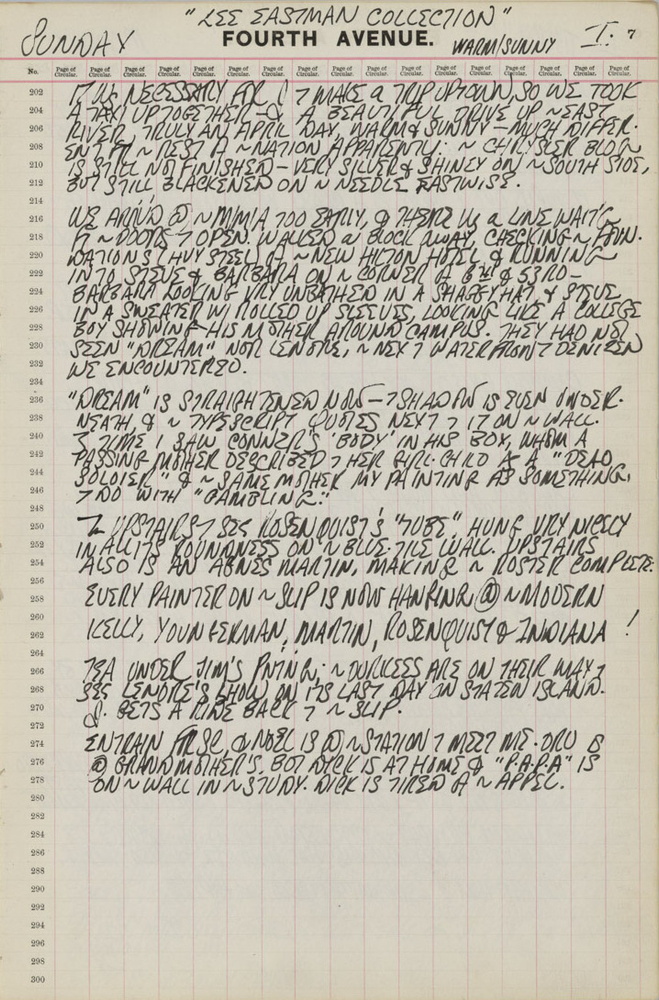
Robert Indiana kept a series of illustrated journals during the late 1950s and 1960s, in which he discusses the development of his work as well as his daily life on Coenties Slip.
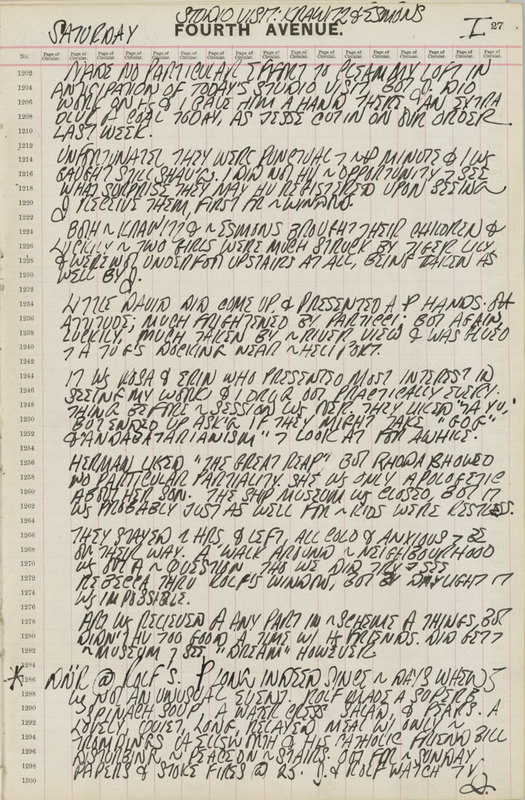
In his journal entry for January 27, 1962, Indiana describes a studio visit by Herman and Rhoda Krawitz, and Aaron and Rosa Esman, noting that they were punctual to the minute, catching him still shaving, and that they both brought their children along. Herman Krawitz was an assistant manager at the Metropolitan Opera, and Rosa Esman ran the Tanglewood Gallery.
Indiana writes that it was the Esmans "who presented most interest in seeing my work, and I dug out practically everything before the session was over," and that they asked if they could take Gog and Andabatarianism (renamed Made in USA) to look at for a while. Regarding the Krawitzes he records that Herman liked The Great Reap, but that Rhoda "showed no particular partiality." He adds that they were there for two hours and left "all cold and anxious [to] be on their way. A walk around [the] neighborhood was out of [the] question. Though we did try to see Rebecca [The Fair Rebecca] through Rolf’s [Nelson] window, but by daylight it was impossible."
Indiana also records that Arthur Carr (a clinical psychologist and collector) made it to the Museum of Modern Art to see The American Dream, I, and that he and J. (his partner fashion designer John Kloss) had dinner at Nelson's, "a lovely, quiet, long, relaxed meal."